.png)
An Information portal with Shopping, People, Places & Interesting Facts
A
Art/Decor
Vintage Maps
B
Baby Items
Bonsai
Books
Boots Women
C
Cactus
Calendars
Coffee
Company Index
Curtains
H
Handbags
Harry Potter
Hats Women's
J
Jewelry
Q
Q&A
R
Rugs
S
Scarves Women
Socks Men
Shoes Women
Shoes Men
Software
Sunglasses
W
Wallets
Watches Men's
Watches Women's
Web Hosting
Web Themes
World Cup
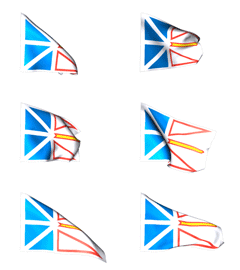
Newfoundland and Labrador is the easternmost province of Canada. Situated in the country's Atlantic region, it is composed of the insular region of Newfoundland and the continental region of Labrador to the northwest, with a combined area of 405,212 square kilometres (156,500 sq mi). In 2018, the province's population was estimated at 525,073. About 92% of the province's population lives on the island of Newfoundland (and its neighbouring smaller islands), of whom more than half live on the Avalon Peninsula.
The province is Canada's most linguistically homogeneous, with 97.0% of residents reporting English (Newfoundland English) as their mother tongue in the 2016 census. Historically, Newfoundland was also home to unique varieties of French and Irish, as well as the extinct Beothuk language. In Labrador, the indigenous languages Innu-aimun and Inuktitut are also spoken.
Newfoundland and Labrador's capital and largest city, St. John's, is Canada's 20th-largest census metropolitan area and is home to almost 40 per cent of the province's population. St. John's is the seat of government, home to the House of Assembly of Newfoundland and Labrador and to the highest court in the jurisdiction, the Newfoundland and Labrador Court of Appeal.
A former colony and then dominion of the United Kingdom, Newfoundland gave up its independence in 1933, following significant economic distress caused by the Great Depression and the aftermath of Newfoundland's participation in World War I. It became the tenth province to enter the Canadian Confederation on 31 March 1949, as "Newfoundland". On 6 December 2001, an amendment was made to the Constitution of Canada to change the province's name to Newfoundland and Labrador.


